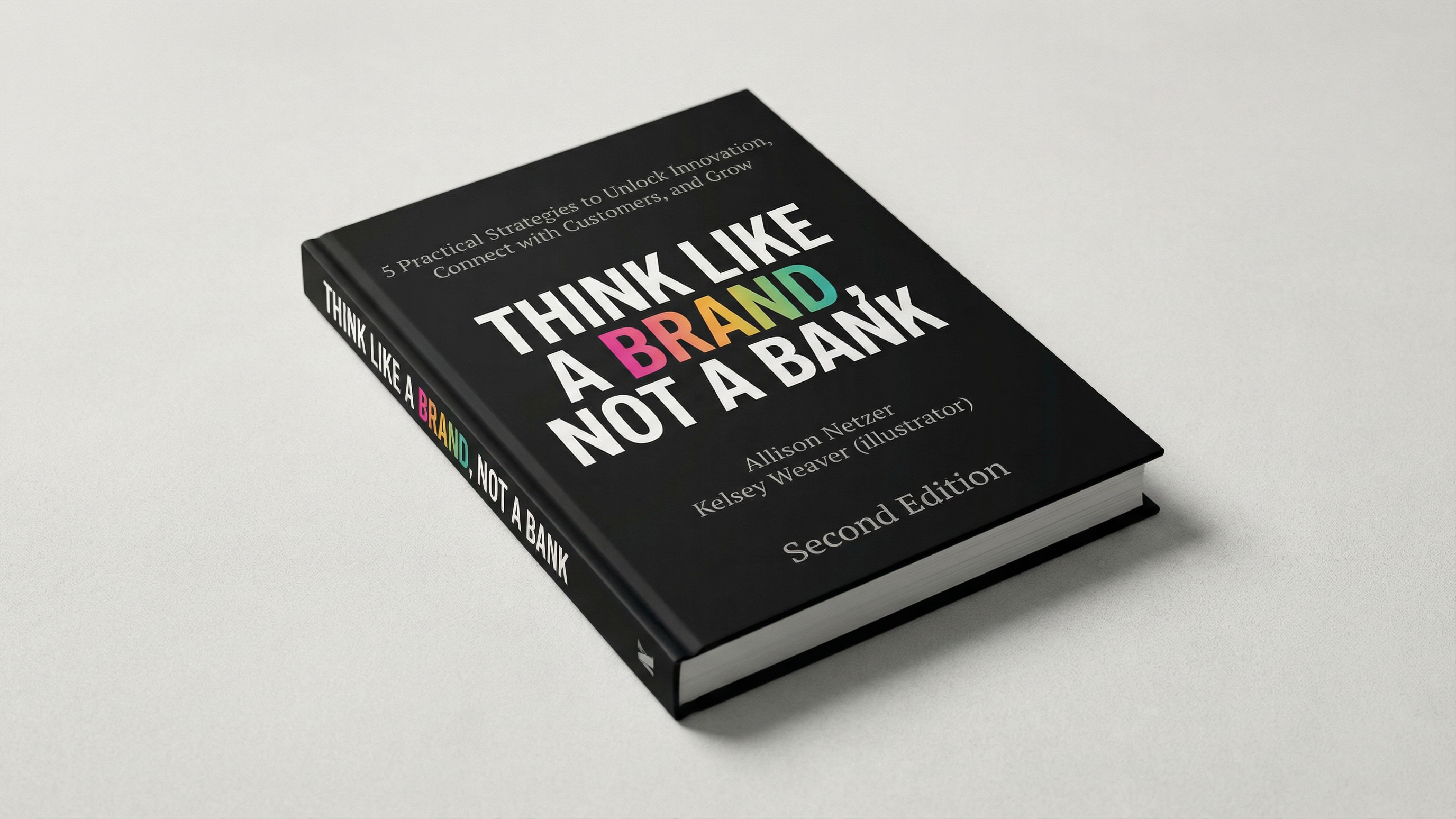
When everyone has a good product, brand becomes your only advantage.

Brand strategist Allison Netzer challenges readers to abandon conventional "bank thinking" and embrace the bold, counterintuitive strategies that define iconic brands. Through practical frameworks like Box to Edge, the Salt Shaker Theory, and Pain to Promise to Proof, this book shows how to transform from commodity provider into a brand customers genuinely connect with.

Who it's for
  • CEOs watching inferior competitors win on pricing while you struggle to articulate what makes you different
  • CMOs and Marketers stuck in campaign mode without organizational buy-in to build something that lasts
  • Fintech Founders realizing product innovation alone won't scale. You need a brand that compounds.
  • Operators who know their daily decisions either reinforce or undermine the brand promise
Included free: TLAB 2 Toolkit
Five frameworks built from real client work. Each one gives your team something they can use in their next leadership meeting.

Frameworks that stick

These aren't theoretical models. They're practical tools built from real client work with fintechs and financial institutions. Use them in your next leadership meeting.

01
Pain to Promise to Proof
The narrative sequence that matches how brains process decisions. Most banks reverse this. That's starting at step 3 when brains need to start at step 1.
02
Box to Edge
Establish category credibility first, then differentiate. If a stranger can't categorize you in 5 seconds and articulate your difference in 10, you're asking brains to work too hard.
03
The Assumption Trap
Success breeds certainty. Certainty breeds assumptions. Assumptions quietly erode the curiosity that drives growth. Your biggest competitor is believing you already understand your market.
04
Salt Shaker Theory
Set the standard. Expect drift. Provide gentle correction. The job isn't preventing drift. It's consistent, gentle correction back to standard.
05
F/M/B Model
Frontline, Midline, Backline. Structure for operationalizing brand. Brand isn't what marketing says. It's what every person in your organization does when no one's watching.
06
Infrastructure Test
Does this positioning require you to build or change infrastructure? If yes, it's genuinely differentiating. The resistance IS the signal.
Readers

What people are saying

"You absolutely nailed it. So much good, applicable, relevant information in every chapter."
Josh Herman, CU Wealthnext
"I think you've really done a great job using the brain science framework to explain your concepts in a simple way."
Jim Eup, Vericast
"I found myself nodding quite a bit reading this."
Jeff McCarthy, Bank Five Nine

Five principles that change everything

These principles run through every chapter. They're counterintuitive on purpose. Your brain resists them biologically. That resistance signals you might be onto something.

Do the Counterintuitive Thing
Pattern violations force attention. Attention creates memory. Expect resistance. It signals you might be onto something.
Embrace Tension and Create Contradictions
Tension isn't a bug. It's a feature. The strings of a piano are tightened to extreme tension. That's what makes the sound.
Cue the Remix
You're not inventing from scratch. Take what you have and recombine in ways that solve problems differently. Fire bullets, then cannonballs.
Product Is Proof, Not Promise
Your mobile app, rates, and platform prove you can deliver. But the promise itself is what you enable customers to do or become.
Coach and Compose
Innovation without implementation is expensive brainstorming. Medals are won in training. You claim them in the race.
About the Author

Allison Netzer

Allison Netzer

Allison Netzer is a brand strategist who works with fintechs and financial institutions building growth brands. She's spent her career helping organizations move from commodity provider to category leader by challenging the assumptions that keep them stuck. Think Like a Brand, Not a Bank distills two decades of client work into frameworks you can use tomorrow.

Ready to think like a brand?